

Ice that took around 2,000 years to form on Mount Everest’s highest glacier has melted in just 25 years, scientists have warned.
Ice on the South Col Glacier (SCG) has shrunk 80 times faster than it formed, according to a new report published by international scientific journal, Nature.
Research led by the University of Maine in the US found around 55m (180ft) of ice has been lost.
Now scientists say ice which took decades to accumulate could rapidly recede – amid fears the rest of the glacier could disappear within the next 25 years.
The report said: “Thinning could occur in 25 years, over 80 times faster than it took to form the ice now exposed at the surface of SCG.
“Estimated contemporary thinning rates…indicate several decades of accumulation may be lost on an annual basis now that glacier ice has been exposed.”
While the impact of melting glaciers has been widely studied, little is known about the highest points on the planet including SCG, which has a summit of 8,020m (26,312ft).
Despite its iconic status Mount Everest remains, at its uppermost elevation, a mystery in terms of weather, climate and glacier health, the report said.
The National Geographic and Rolex Perpetual Planet Everest Expedition, launched in 2019, saw scientists journey to the top of the world in a quest for knowledge.
They aimed to undertake the most comprehensive scientific investigation of the Nepalese side of Mount Everest, which sits on the border of China and Nepal.
“It was the most complete scientific experiment ever conducted on the south side of Everest,” expedition lead, Paul Mayewski, told National Geographic.
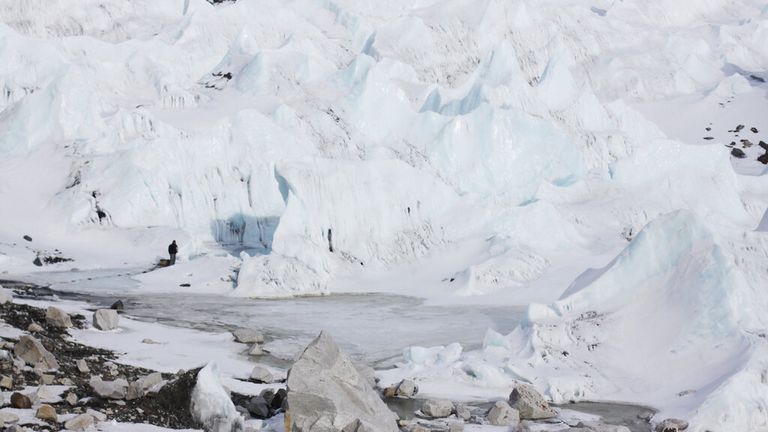
The dramatic icy landscape at Everest Base Camp in Nepal, pictured in 2015 (Pic: AP)
A key part of the research…
Source : skynews


