

The sun’s south pole has been seen for the first time from outside the ecliptic plane in unprecedented images sent back to Earth by a solar orbiter.
The Solar Orbiter spacecraft travelled 15 degrees below the sun’s solar equator to take the images in mid-March – with the European Space Agency (ESA) and NASA revealing them to the world on Wednesday.
It is only the second craft to have passed over the sun’s poles – with the ESA and NASA’s 1990-2009 Ulysses craft lacking the capacity to take any photos.
Read more
Could Britain face a winter ice age?
Will there be a hosepipe ban in the UK?
“Today we reveal humankind’s first-ever views of the sun’s pole,” ESA’s director of science, Professor Carole Mundell, said.
Describing it as a “new era of solar science”, she added: “The sun is our nearest star, giver of life and potential disruptor of modern space and ground power systems, so it is imperative that we understand how it works and learn to predict its behaviour.”
‘Best is yet to come’
According to the ESA, previous images of the sun have been taken from around its equator.
This is because Earth, the other planets, and all other operational spacecraft orbit the Sun within a flat disc around the Sun called the ecliptic plane.
However, by tilting its orbit out of this plane, Solar Orbiter has revealed the star from a whole new angle – and because the spacecraft is set to tilt even further “the best views are yet to come”.
The Solar Orbiter took off from Florida in 2020.
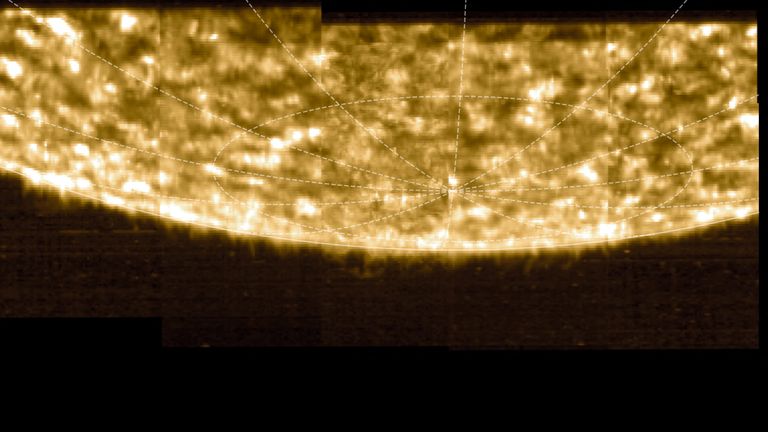
A radiance map of the sun’s south pole as captured by the Solar Orbiter spacecraft. Pic: European Space Agency/Reuters
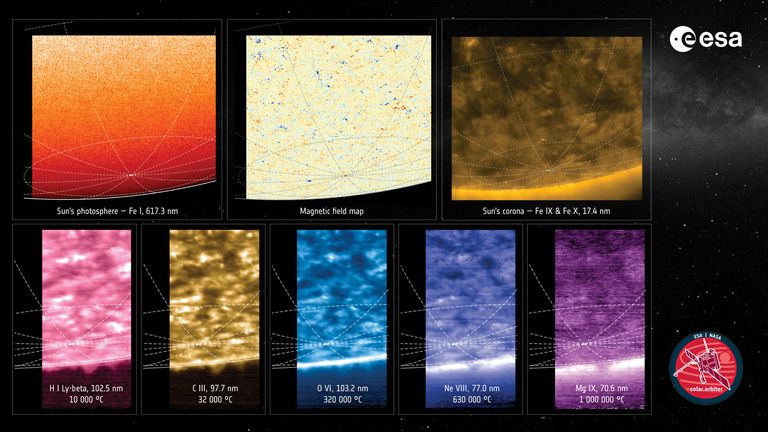
Eight views of the sun’s south pole courtesy of the Solar Orbiter spacecraft. Pic:…


