

[ad_1]
In a war increasingly determined by the flow and price of oil, one country is already emerging as a winner – and it’s not even a combatant.
As US-Israeli strikes on Iran have sent the oil price soaring and raised questions about the American appetite for a prolonged price shock, Russia is already reaping the benefits of higher oil revenues.
The transformation in Russian fortunes, literal and metaphoric, has been dramatic. Just a fortnight ago, Vladimir Putin was under increasing pressure as sanctions tightened.
Iran war latest – follow live
Today, with plentiful supplies of crude oil unconstrained by the effective closure of the Strait of Hormuz, Russia is cashing in.
Not only has the price of Urals crude soared, but the discount Russia was forced to offer as a consequence of sanctions has been erased, delivering a windfall to the Kremlin and its campaign against Ukraine.
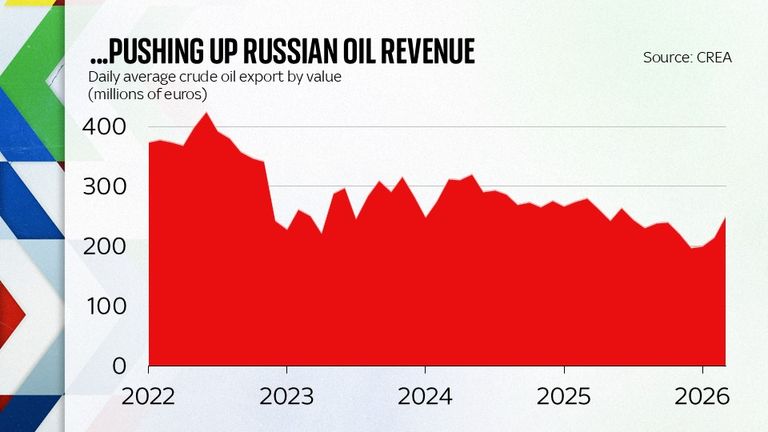
Russian oil revenues fell 18% last year, according to the Centre for Research & Clean Air (CREA), and appeared to be declining further in January, placing genuine pressure on the Russian economy.
At a stroke, the attacks on Iran have eased the pressure, with revenues increasing 17% in the last two weeks and exports from northern Russian ports up 24%.
The change in fortune can be illustrated by the passage of a single vessel in the Russian shadow fleet.
In February, Sky News intercepted the Kousai, a Sierra Leone-flagged tanker, as it passed through the Strait of Dover.
With a capacity of around 750,000 barrels, its cargo was worth around $40m when it was loaded with crude at Ust-Luga in the Baltic on 2 February.
By the time it passed Dover, eight days later, it was potentially worth $42m, as Urals crude traded at $56 a barrel, $13 below Brent crude.
Nine days into the Iranian war, Urals reached a peak of more than $100 a barrel, so as the Kousai passed Sri Lanka en route to India on 9 March, its cargo was…
[ad_2]


