
Why NHS needs time to bring in lightning speed cancer checks | Science

[ad_1]
Google’s AI can identify breast cancer better than a human doctor, and potentially save the stretched NHS a huge amount of time and effort, a new study shows.
If at this point you’re wondering why it isn’t being adopted immediately, well, if you read between the lines, the study shows that too.
It’s a tale which demonstrates the challenges of adopting a new technology, even one with the power to save lives.
The study, published today by Google, the NHS and Imperial College London, took 115,000 breast scans from five NHS screening services and asked an AI and a human specialist to go through them, looking for cancer.
The AI achieved better results than the human, finding around two more cancers per 1000 women.
Significantly, it also detected 25% of “interval cancers’ – cancers diagnosed between routine screening rounds after an earlier scan came up clear – which implies it could help catch breast cancer earlier, a crucial factor in preventing its spread.
Although the AI outperformed a single human, it’s not correct to say it can beat radiologists, because the NHS uses two doctors to go through scans, with a third expert on hand to decide a difference of opinion, a system known as arbitration.
A second Google paper examined the arbitration system and found that, when the human-AI team was compared with a human-human pair, the results were roughly equal.
The AI was slightly better at spotting hard-to-detect cancers, but it tended to flag more cases that didn’t have cancer. Overall, the researchers write that these “differences were not statistically significant”.
AI was not better than a human; it was as good, with the added benefit of offering a different perspective on some invasive cancers, especially among women getting scanned for the first time.
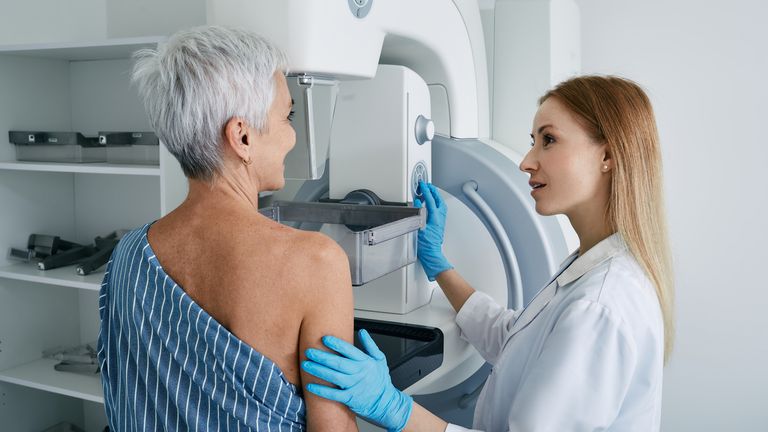
A woman is having…
[ad_2]


