

Stunning images showing distant parts of the universe – including one of a region situated thousands of light years from Earth – have been captured by a powerful new telescope.
The camera at the Vera C Rubin Observatory in Chile is expected to reveal new details from space on an unprecedented scale as it makes further observations during the next decade.
Scientists expect it to chart thousands of asteroids not previously identified – and believe it will discover within months whether there is a ninth planet in our solar system.
The new images show the light from millions of stars and galaxies in observations which took the world’s largest and most powerful camera only 10 hours to complete.
One image shows a mosaic of the Trifid and Lagoon nebulae, a star-forming region which is 9,000 light years from Earth.
A single light year is the distance light travels in 12 months. In space, it “zips through at 186,000 miles per second and 5.88 trillion miles per year”, says NASA.
Another image shows thousands of galaxies in the Virgo Cluster, in what scientists said offers just a “peek at the cosmos”.
The observatory is jointly funded by the National Science Foundation, an independent agency of the US government.
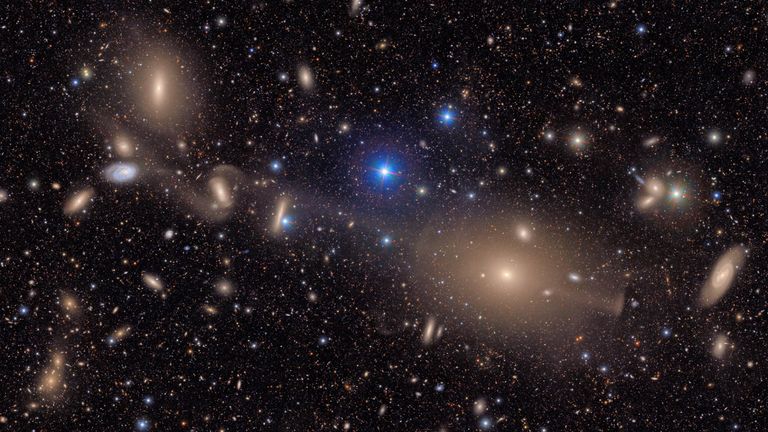
The first images offer a small taste of what might come. Pic: NSF-DOE Vera C Rubin Observatory
The foundation’s chief of staff Brian Stone told CNN the observatory “will capture more information about our universe than all optical telescopes throughout history combined”.
Rubin has been built on a mountain in the Andes, a region in central Chile which is also home to other observatories due to its dry air and dark skies.
The telescope’s work will “capture the cosmos in exquisite detail” as it repeatedly scans the sky for 10…


