

[ad_1]
It’s the mother of all break-ups.
The life of one of the world’s largest and longest lasting icebergs is finally coming to an end after it drifted away from Antarctica nearly 40 years ago.
In March, we flew over megaberg A23a after it ran aground off South Georgia, one of the UK’s most remote overseas territories.
Back then it was a trillion-tonne block of ice more than twice the size of Greater London.
There were concerns its collapse close to the island might endanger globally significant populations of penguins, seals and seabirds.
But a few months later the iceberg floated free and began drifting again, looping around to the north of South Georgia where now, in the Antarctic spring, it is finally falling apart.
“It’s been exposed to warmer waters for quite a long time,” said Andrew Meijers, an oceanographer at the British Antarctic Survey in Cambridge.
“So it’s pretty much rotted through.”
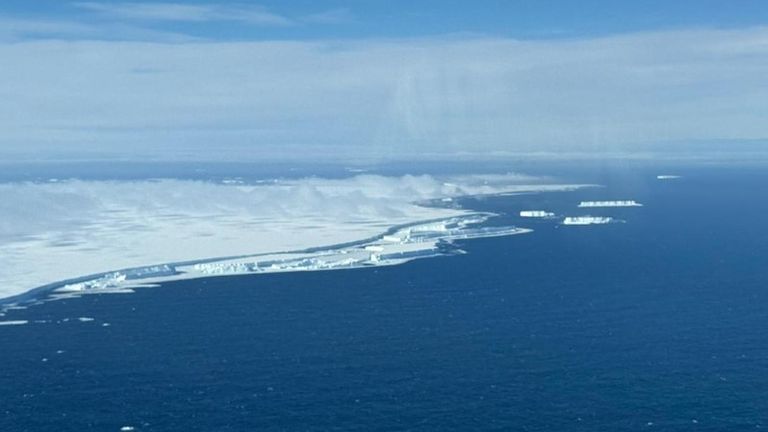
Pic: MoD/SGSSI Government
Satellite images from the last few days now reveal “we’ve got really big chunks breaking off,” said Meijers.
The largest piece to come away in the last few days is 80 sq km – a colossal iceberg in its own right.
A23a is still 1,700sq km – larger than London – but will now rapidly disappear.
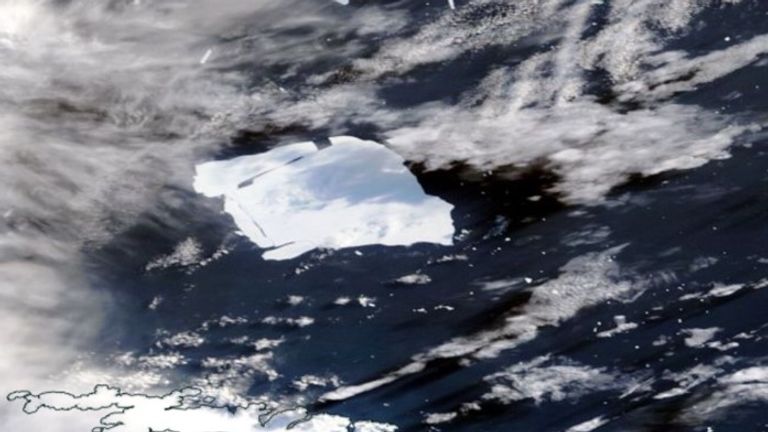
Latest satellite images of the iceberg. Pic: NASA Worldview
‘It’s not going to last for more than a few weeks’
“It’s not going to last in that chunk format for more than a few weeks or a month at most,” predicts Meijers.
As the iceberg breaks up, the surface area of pieces exposed to warmer water increases, accelerating its melting.
It’s also now caught in a current carrying it northwards, into increasingly milder temperatures.
The rapid break-up of A23a…
[ad_2]


