

A colossal squid has been filmed in its natural environment for the first time – exactly 100 years after the species was first identified.
The footage was recorded in March by a team of international scientists on an expedition searching for new marine life.
Measuring just 30cm long, the juvenile squid was spotted at a depth of 600m (1,968ft) near the South Sandwich Islands in the South Atlantic Ocean.
Experts believe colossal squid eventually grow up to 7m (23ft) in length – and can weigh up to 500kg (1,100lbs).
That’s equivalent to a Fiat 500 car, making it the heaviest invertebrate on the planet.
The footage was captured by crew on board the Schmidt Ocean Institute’s Falkor (too) vessel, with a remotely operated vehicle called SuBastian filming the video.
Experts from the University of Plymouth and the British Antarctic Survey were among those involved in the 35-day quest.
Dr Kat Bolstad, who helped verify the footage, says that – until now – colossal squid had mainly been encountered as prey remains in whale and seabird stomachs.
“It’s exciting to see the first in situ footage of a juvenile colossal and humbling to think that they have no idea that humans exist,” she added.
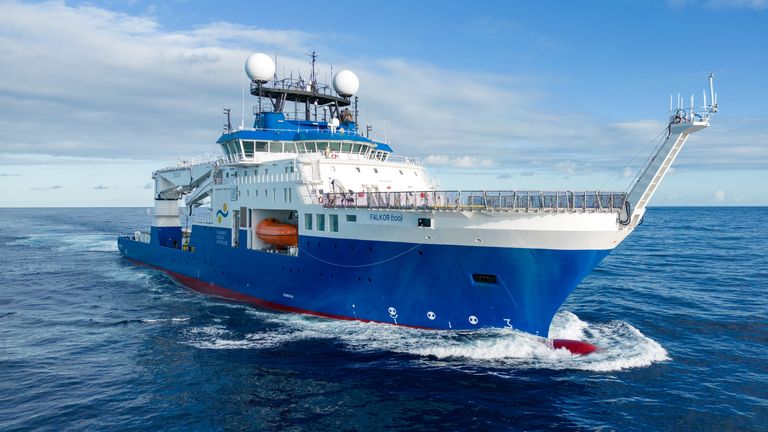
The Falkor (too) vessel – with British scientists on board – was hunting for new marine life. Pic: Schmidt Ocean Institute
The colossal squid remains shrouded in mystery – and while little is known about their lifecycle, adults eventually lose the see-through appearance of juveniles.
Another distinguishing characteristic of this species – formally known as Mesonychoteuthis hamiltoni – is the presence of hooks on the middle of their eight arms.
Read more science news:
Game-changing space factory to launch
‘Tropical nights’ in Europe…


