

An 88-year-old grandmother who lost the sight in her left eye has become the first person in the UK to detect signals in it using a “revolutionary” new bionic chip.
The woman suffers from geographic atrophy – the most common form of dry age-related macular degeneration (AMD).
This causes a blind spot to develop in the middle of the eye.
It is estimated that the condition affects more than five million people worldwide.
The octogenarian from Dagenham, London, received the implant at Moorfields Eye Hospital as part of a Europe-wide clinical trial.
In a statement, she said she hoped the implant would allow her to do the things she loved again.
“Losing the sight in my left eye through dry AMD has stopped me from doing the things I love, like gardening, playing indoor bowls and painting with watercolours,” she said.
“I am thrilled to be the first to have this implant, excited at the prospect of enjoying my hobbies again and I truly hope that many others will benefit from this too.”
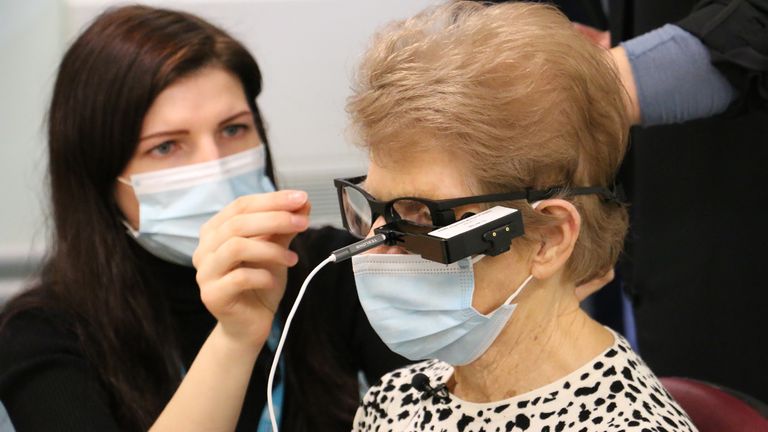
The implant works by surgically inserting a 2mm wide microchip under the centre of a patient’s retina
How does ‘revolutionary’ new bionic chip work?
The implant works by surgically inserting a 2mm wide microchip under the centre of a patient’s retina.
The patient then wears special glasses, containing a video camera that is linked to a small computer attached to their waistband.
The chip captures the video provided by the glasses, and in turn transmits this to the computer, which uses artificial intelligence algorithms to process this information and guide the focus of the glasses.
Finally, the glasses project this image as an infrared beam back through the eye to the chip, which transforms this into an electrical signal that travels…
Source : skynews


