

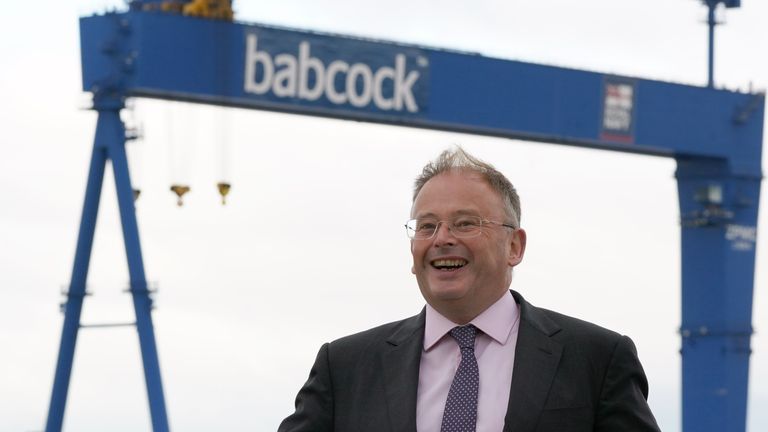
Few businesses have had as lively a decade and a half as the defence and engineering services contractor Babcock International.
The company’s work ranges from delivering the Royal Navy’s new type 31 frigate and training pilots for the British and French militaries to helping decommission the old Dounreay nuclear establishments in the Scottish Highlands.
Under its former chief executive, the late Peter Rogers, Babcock – one of the storied names of UK engineering – embarked on a dramatic acquisitions spree that took it into the FTSE 100.
It first paid £350m in 2007 for the vast Devonport Royal Dockyard complex in Plymouth, at a stroke making Babcock the sole supplier of refit and maintenance services to the UK’s nuclear submarine fleet, as well as becoming the biggest single supplier to the Royal Navy.
Mr Rogers, one of the last of the old-style bruisers that used to dominate British industry, followed that in 2010 with the £1.32bn takeover of VT Group, the old Vosper Thorneycroft, another major support services business.
Then in 2014 he spent a further £1.6bn on the takeover of the helicopter operator Avincis.
That Babcock’s stock market valuation today is only £1.55bn gives the casual observer a clue that at least some of these acquisitions – chiefly the last one – did not go entirely to plan.
The company dropped out of the Footsie at the end of 2017 as investors fell out of love with the services sector following a series of high-profile problems at the likes of G4S, Capita, Serco, Interserve and Carillion.
Worse was to follow when, in 2018, Babcock found itself targeted by an anonymous research outfit called Boatman Capital which made a number of allegations about the company’s relationship with the Ministry of Defence and, more seriously, accused it of misleading investors with some tricksy accounting.
…
Source : skynews


