

“AI has changed my life, absolutely,” Lucas Horne tells Sky News. “When I play my music, I’m happy because the words I know mean a lot to me can now be heard by everyone else.”
Lucas was 17 when, in December 2016, with no warning, he suffered a large, traumatic bleed across his brain.
He didn’t wake up until almost four months later.
Unknowingly, he had been living with a defect in the blood vessels known as an AVM (arteriovenous malformation), a ticking time bomb which had ruptured, and the next three years of his life were spent in recovery in a care home.
He couldn’t walk and struggled to talk. Writing down his thoughts, almost like a diary, was something he says he wanted to do from very early on.
“During my care home days when I couldn’t really express myself very well – I still can’t – but I could write about it, it was an outlet for me,” he says. “Since I woke up, I’ve been writing… but for a long time I couldn’t record anything.”
Lucas, now 26, has spent years working on his physical recovery and speech. But when he was eventually physically able to record the songs he had been writing himself, he became frustrated by the way his voice had changed.
“It never sounded how I had [it in] my head,” he says. “I’m very monotone in how I speak, I struggle to really display emotion.”
And so he turned to AI (artificial intelligence). Now, Lucas is also known as The BTO Kid, and is one of 15 creators from around the world, shortlisted from more than 500 entries, for the inaugural Future Sound Awards – celebrating artificial intelligence in music.
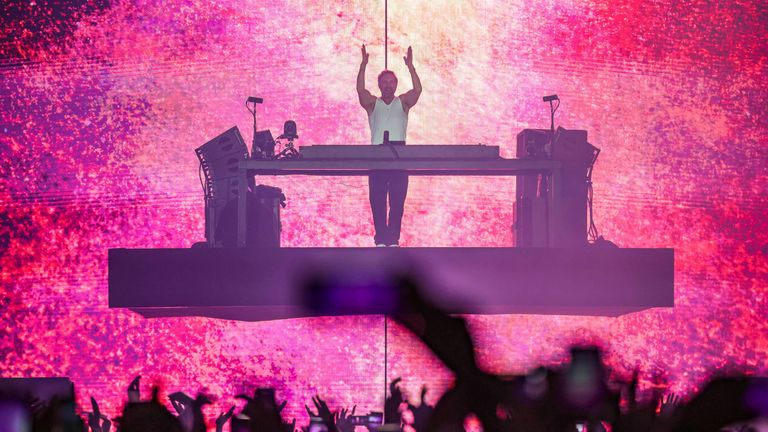
DJ David Guetta is among the big-name artists who have embraced AI. Pic: Christoph Reichwein/picture-alliance/dpa/AP July 2025
While some artists such as…


