

[ad_1]
With a prime minister under extreme fire and unable to command a majority in the Commons on matters of personal authority, is politics too self-absorbed to fix a problem as broken as the system for special educational needs provision?
Plans to reform the 12-year-old approach to SEND are expected to be announced within weeks – but how bold will they be given the complexity and opposition ministers are likely to encounter?
That’s the question at the heart of a Sky News investigation revealing the scale of the political challenge around reforming the system.
Figures from the Department for Education found one in five children were identified as having special educational needs, with most supported by their existing schools.
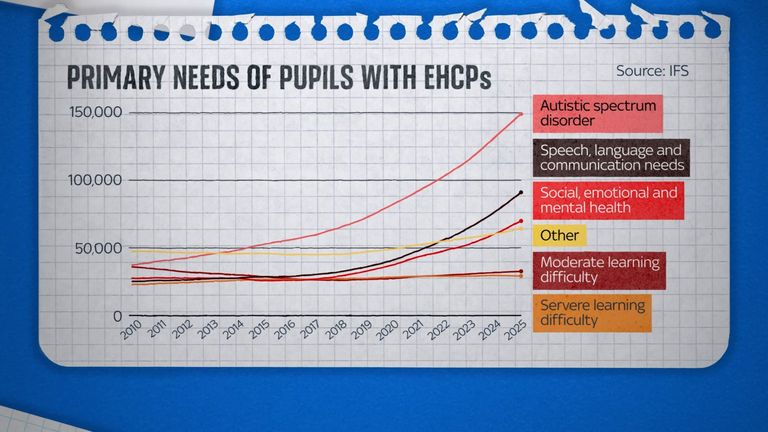
But a growing minority of these children have been given specific funding and legally enforceable programmes to meet their needs, via education, health and care plans (ECHPs), which can provide access to special or independent special schools. The number of these has nearly doubled since 2017 and is due to rise further to the end of the decade.
This boom has led to long wait times – 6,500 children waited over a year for a EHCP in 2024 – and professionals who are overwhelmed with paperwork rather than directly supporting children.
Meanwhile, unhappy families who initially fail to secure an EHCP are increasingly going to court to secure support. In 2023, there were 21,000 appeals, with 99% going in favour of parents. The biggest rise of all in ECHPs is an increase in diagnosis of pupils with autism.
As a result, high needs spending by local authorities has exceeded funding for years.
The Institute for Fiscal Studies had projected the annual deficit to be £6bn in two years time, although the government has committed to paying off 90% of the deficits that councils have accrued over the last decade.
Without reform, however, the costs will continue to outstrip funding and…
[ad_2]


