

SpaceX’s most powerful rocket has launched in a landmark mission from NASA’s Kennedy Space Center.
It marked only the fourth take-off for the Falcon Heavy, its first in more than three years, and saw it fitted with three Falcon 9 boosters.
The boosters, which regularly launch on their own to carry SpaceX‘s Starlink satellites up into orbit, were needed to provide their bigger brother with the necessary thrust to reach the stars.

…and heading for orbit
In the payload for the USSF-44 mission from Florida’s Cape Canaveral were two US Space Force craft, including a microsatellite dubbed TETRA-1, which was created for “various prototype missions”.
The other craft being carried is classified.
Problems with getting the payload ready had delayed the launch multiple times – it was originally scheduled to take place back in 2020.
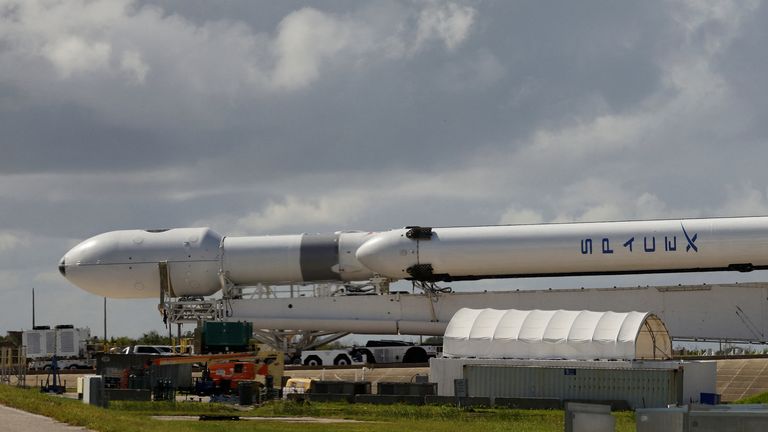
The SpaceX Falcon Heavy rocket rolls to launch pad 39A at NASA’s Kennedy Space Center
How the launch played out
The launch began at 9.41am local time (1.41pm UK).
Conditions were favourable ahead of the rearranged take-off date, with blue skies greeting the rocket as it rolled towards launch pad 39A on Monday.
Although heavy fog had descended on the site by Tuesday morning, it still launched off on time.
Just over a minute after launch, the moment of peak mechanical stress on the rocket was reached – shortly after, its two side boosters had their engines cut and separated from the main rocket.
Both landed at SpaceX’s landing zones at Cape Canaveral around eight minutes after launch.
The main rocket had left Earth’s atmosphere by then, before the payload separated.
“Sonic BOOMS!!” tweeted SpaceX boss Elon Musk as the boosters landed.
‘It’s just incredible’
Huge cheers greeted the sight of the boosters…
Source : skynews


