

[ad_1]
In the English Channel, less than two hours by fishing boat from Dover, some of the most potent weapons in Russia’s war on Ukraine are hiding in plain sight.
On a misty February morning midway between Britain and France, we watch tankers carrying Russian oil worth around $100m (£74.1m) cruise past in defiance of Western sanctions, embargoes, and price caps.
Dozens of these vessels pass through the Channel every month, part of a “shadow fleet” of up to 800 vessels that have kept the oil revenues that fund the war on Ukraine flowing.
This week, the UK government announced fresh sanctions against the Russian oil trade but the evidence of a day on the water is that the shadow fleet operates with apparent impunity, right under the nose of Kyiv’s allies.
Russian tankers a ‘routine sight’
Our skipper, Matt Coker, usually takes sea fishing parties out on the Portia, but we were after a bigger catch; three vessels in the shadow fleet carrying oil from Russia’s Baltic ports.
He says they are a routine sight in the world’s busiest shipping lane: “When you see these Russian ships and these oil tankers, you know, it’s a regular occurrence. To be honest, no one really takes any notice.”
We had tracked the tankers – the Rigel, the Hyperion and the Kousai – from the Gulf of Finland, where they had been loaded with oil at Russian Baltic ports, to intercept them as they passed the narrowest point of the Dover Straits.
Up close in a rising swell, the scale of the vessels is unavoidable, and each one tells a story about both the impact and the limits of Western action.
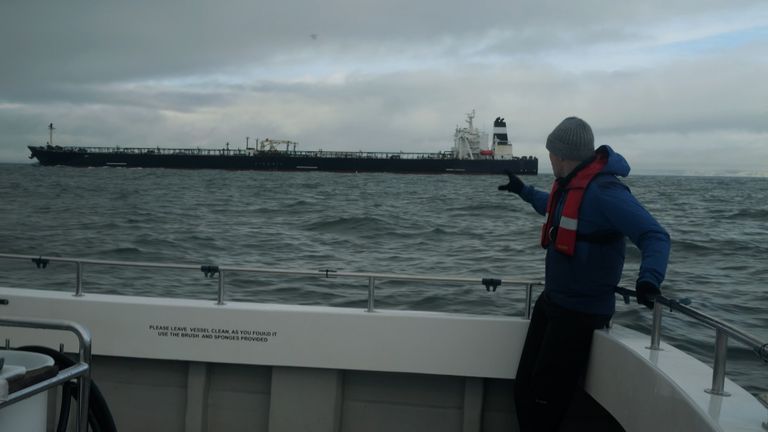
Sky’s Paul Kelso and the Rigel in the Channel
The Rigel, a Suezmax-class tanker, is more than 270 metres long and fills the near horizon as it emerges from the mist. With a capacity of one million barrels, its cargo of…
[ad_2]


