

[ad_1]
Sir Keir Starmer was the first leader to arrive at this meeting in Paris, strolling down the road from the British Embassy.
When he emerged, after three hours of discussion, he looked sombre.
Sir Keir, like the other political heavyweights who came to the Elysee Palace, knows that Europe has been battered and marginalised over the past week or so by the actions and rhetoric that have come out of Washington.
So this meeting was, to an extent, about political leaders reasserting themselves.
But when we spoke, it was clear that it was also about laying down a line.
Not so much about what a peace deal for Ukraine might look like, but how it would be policed.
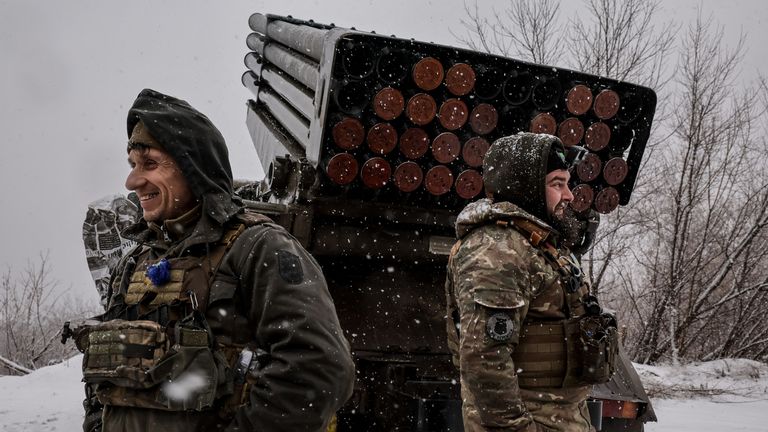
Ukrainian troops in the in the Donetsk region. Pic: Reuters
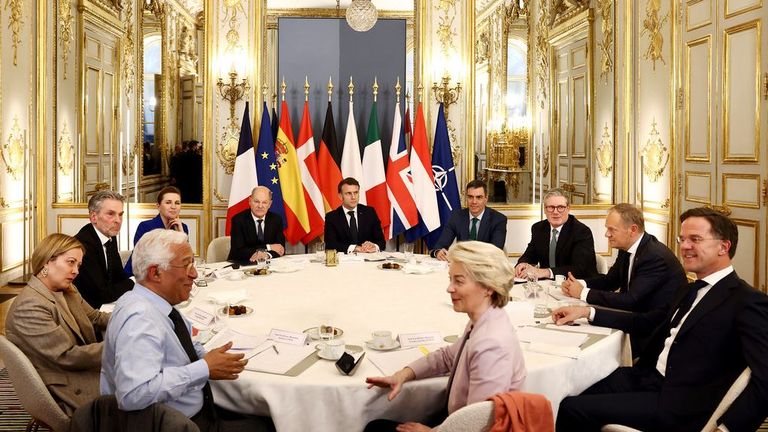
European leaders at the security summit in Paris. Pic: Number 10/Flickr
The prime minister said he was prepared to deploy British troops on the ground but was emphatic that the US would have to provide what he called a “backstop”.
He didn’t elaborate on exactly what this would mean, but it’s clear that he’s talking about America committing its military muscle to secure Ukraine’s future.
“A lasting peace”, as the prime minister insists, rather than a ceasefire that, European leaders believe, will simply allow Vladimir Putin to regroup his forces and launch another offensive.
Sir Keir is trying to flex some diplomatic muscles – striking a more strident tone than, say, Olaf Scholz, the surely-soon-to-be former chancellor of Germany, while also promising to go to Washington next week for talks with Donald Trump, and then reporting back to European leaders.
It is, one suspects, a rare chance for Sir Keir to take a leadership role…
[ad_2]


