

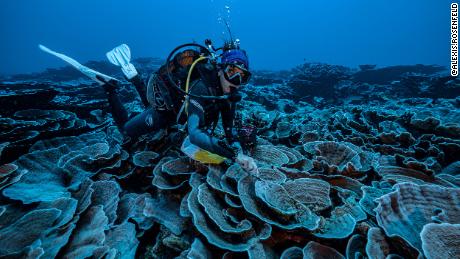
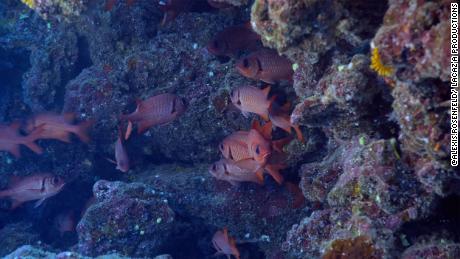
That a coral reef so large and so beautiful had yet to be discovered emphasizes how little we still know about the world’s oceans, scientists say. And its impeccable condition — with no evidence that the reef has yet been harmed by the climate crisis — suggests the need for urgent action to protect the ocean’s remaining healthy reefs.
Alexis Rosenfeld, the photojournalist who led the team of international divers, said the reef, which stretched “as far as the eye can see,” was “magical to witness.”
“It was like a work of art,” he said.
The research mission, led by UNESCO, found the reef stretches for nearly two miles and exists at depths down to 70 meters, or 230 feet. This is around the ocean’s “twilight zone,” where there’s just enough light to sustain life, and below which the ocean transitions into a dark abyss.
“For once, it’s a positive story about coral reefs in the news, which is quite rare these days,” Julian Barbiere, head of marine policy at UNESCO, told CNN.
Only around 20% of the ocean floor has so far been mapped, according to UNESCO. And until its latest discovery, the vast majority of the planet’s known coral ecosystems were believed to extend to a depth of just 25 meters, illustrating how much of the ocean — which covers more than 70% of Earth’s surface — still needs to be explored.
“The discovery suggests that there are, in fact, many more large reefs out in our ocean at depths of more than 30 meters, which have not been mapped,” Barbiere said. “It’s quite a puzzling finding.”
“While we are witnessing major investment in space exploration, there’s not enough on studying our own…
Source : cnn


