

“Parker Solar Probe ‘touching the Sun’ is a monumental moment for solar science and a truly remarkable feat,” said Thomas Zurbuchen, the associate administrator for NASA’s Science Mission Directorate, in a statement.
“Not only does this milestone provide us with deeper insights into our Sun’s evolution and (its) impacts on our solar system, but everything we learn about our own star also teaches us more about stars in the rest of the universe.”
The sun’s corona is much hotter than the actual surface of the star, and the spacecraft could provide insight about why. The corona is one million degrees Kelvin, while the surface is around 6,000 Kelvin.
Now, thanks to Parker’s latest close approach to the sun, the spacecraft helped scientists determine that these switchbacks originate from the solar surface.
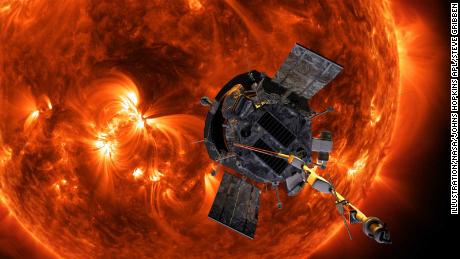
Before Parker Solar Probe’s mission is done, it will have made 21 close approaches to the sun over the course of seven years. The probe will orbit within 3.9 million miles of the sun’s surface in 2024, closer to the star than Mercury — the closest planet to the sun.
Although that sounds far, researchers equate this to the probe sitting on the four-yard line of a football field and the sun being the end zone.
“Flying so close to the Sun, Parker Solar Probe now senses conditions in the magnetically dominated layer of the solar atmosphere — the corona — that we never could before,” said Nour Raouafi, Parker project scientist at the Johns Hopkins Applied Physics Laboratory in Laurel, Maryland, in a…
Source : cnn


