

[ad_1]
More than a decade after a mysterious killer devastated sea star populations along the Pacific coast of North America, scientists believe they have finally found the culprit.
The mass die-off, which began in 2013, wiped out an estimated five billion sea stars from Mexico to Alaska, and continues to affect over 20 species.
“It’s really quite gruesome,” said Alyssa Gehman, marine disease ecologist at the Hakai Institute in British Columbia, Canada, who helped identify the cause.
She said healthy sea stars – also known as starfish – have “puffy arms sticking straight out”.
But the wasting disease that set in more than a decade ago caused them to grow lesions and “then their arms actually fall off”.
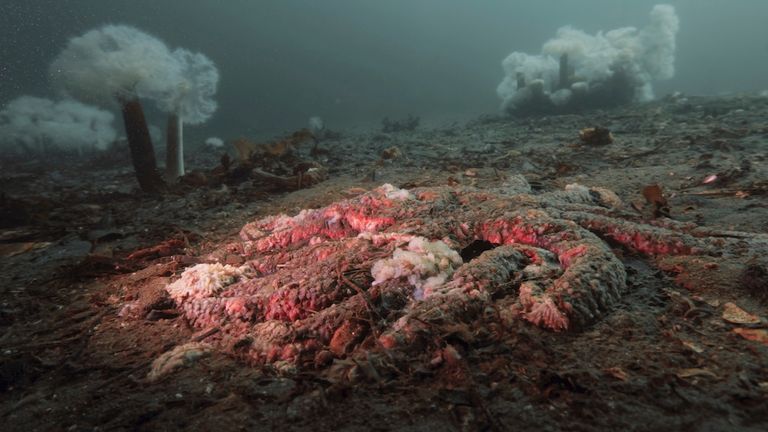
A sunflower sea star infected by sea star wasting disease in British Columbia, Canada, in 2015. Pic: Hakai Institute/AP
Worst hit was the sunflower sea star species, which lost around 90% of its population in the outbreak’s first five years.
After following numerous wrong turns and red herrings, scientists are now confident the killer was a bacterium that also infected shellfish.
The breakthrough, published in the journal Nature Ecology and Evolution, solves “a long-standing question about a very serious disease in the ocean,” said Rebecca Vega Thurber, a marine microbiologist at the University of California, Santa Barbara, who was not involved in the study.
Previous efforts missed the real killer because they focused on the wrong type of virus or investigated samples of dead sea stars which no longer contained the bodily fluid that surrounds the organs.
But the latest study involved careful analysis of this so-called coelomic fluid, and found the pathogenic bacteria Vibrio pectenicida.
[ad_2]


