

The NASA Juno mission, which began orbiting Jupiter in July 2016, just recently made its 38th close flyby of the gas giant. The mission was extended earlier this year, adding on a flyby of Jupiter’s moon Ganymede in June.
The data and images from these flybys is rewriting everything we know about Jupiter, said Scott Bolton, Juno principal investigator at the Southwest Research Institute in San Antonio, during a briefing at the American Geophysical Union Fall Meeting in New Orleans on Friday.
There, Bolton revealed 50 seconds of sound created when Juno flew by Ganymede over the summer. The clip of the moon’s audio was created by electric and magnetic radio waves produced by the planet’s magnetic field and picked up by the spacecraft’s Waves instrument, designed to detect these waves. The sounds are like a trippy space age soundtrack.
“This soundtrack is just wild enough to make you feel as if you were riding along as Juno sails past Ganymede for the first time in more than two decades,” Bolton said. “If you listen closely, you can hear the abrupt change to higher frequencies around the midpoint of the recording, which represents entry into a different region in Ganymede’s magnetosphere.”
The Juno team continues to analyze the data from the Ganymede flyby. At the time, Juno was about 645 miles (1,038 kilometers) from the moon’s surface and zipping by at 41,600 mph (67,000 kilometers per hour).
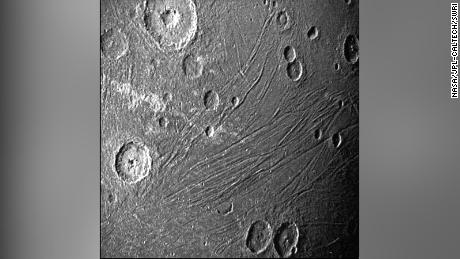
“It is possible the change in the frequency shortly after closest approach is due to passing from the nightside to the dayside of Ganymede,” said William Kurth, lead co-investigator of the Waves instrument, who is based at the University of Iowa in Iowa City, in a statement.
The team also shared stunning new images that resemble artistic views of Jupiter’s swirling atmosphere.

“You can see how incredibly beautiful Jupiter is,” Bolton said. “It’s really an artist’s palette. This is almost like a Van Gogh painting. You see these incredible vortices and swirling clouds of different…
Source : cnn


