

[ad_1]
A yellow ambulance arrives and 82-year-old Margaryta Zatuchna, slight of frame with thick round glasses and a never-ending smile, steps out. She is handed two bouquets of roses, one orange and the other white.
She bows her head slightly and inhales deeply to smell each bunch. She is finally safe.
Born in January 1940 in the northeastern Ukrainian city of Kharkiv, Margaryta’s life began as Adolf Hitler ordered the extermination of Jewish communities across Europe.
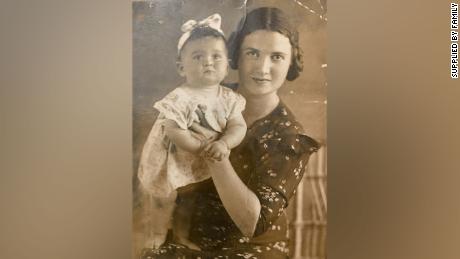
Days before the Nazis invaded her hometown in October 1941, she was evacuated to a village in the Ural mountains, now part of Russia, with her family by the then Soviet-owned turbine plant, where her father was employed.
“His plant was evacuated with all the equipment to the east,” she said, adding that she and her mother went too.
Between 1941 to 1943, the plant’s workers switched from making turbines to manufacturing mortars and repairing tanks for Soviet troops, she said.
“We were put in a small village with little huts, at the end of it there was a forest,” she recalled. “Sometimes wolves would come to us, but the little children did not understand the danger.”
After the Red Army regained control of the city in 1943, Margaryta returned to Kharkiv with her family and grew up under Soviet rule.
She finished her university education and became an engineer, got married and had a son. Later she divorced and remarried in her 40s to Valerii Verbitski, whom she described as a “good man.”
Her life was simple and peaceful.

‘Explosion after explosion’
That peace lasted until February 24, when Russian forces launched an unprovoked attack on Ukraine, barreling through her city, shelling neighborhoods, blowing up a government building, and encircling Kharkiv’s estimated 1.4 million residents.
“There was no water or power, we couldn’t buy food. It…
[ad_2]
Source : cnn


