

[ad_1]
The cost of long term UK government borrowing has hit a fresh 27-year high but the governor of the Bank of England has talked down its importance as chancellor Rachel Reeves battles challenges to the public finances..
The interest rate demanded by investors on the state’s long-dated borrowing (30-year bonds) rose to just below 5.75%, surpassing the 5.72% peak reached on Tuesday, pushing it to a high not seen since May 1998.
The latest movements took place a day after the government auctioned off a record series of 10-year loans – and was forced to pay a premium to do so.
Issuing bonds is a routine way states raise money.
Money blog: Sainsbury’s criticised for trialling ‘spying’ technology
As well as meaning the state has to pay more to borrow money, high interest rates on debt can signify reduced investor confidence in the ability of the UK to pay back these loans.
It is a reason why the chancellor’s budget – set today for late November – has come into such sharp focus in recent weeks.
But the Bank’s governor, Andrew Bailey, told a committee of MPs: “It’s important not to… over focus on the 30-year bond rate.
“Of course, it’s a number that gets quoted a lot, it’s quite a high number, it is actually not a number that is being
used for funding at all at the moment”.
The 30-year yield stood at 5.62% soon after his remarks.
The benchmark for state borrowing costs, the interest rate on 10-year bonds, also saw rises earlier. The yield rose above 4.8% for the first time since January, before slightly falling back
Why did UK debt just get more expensive?
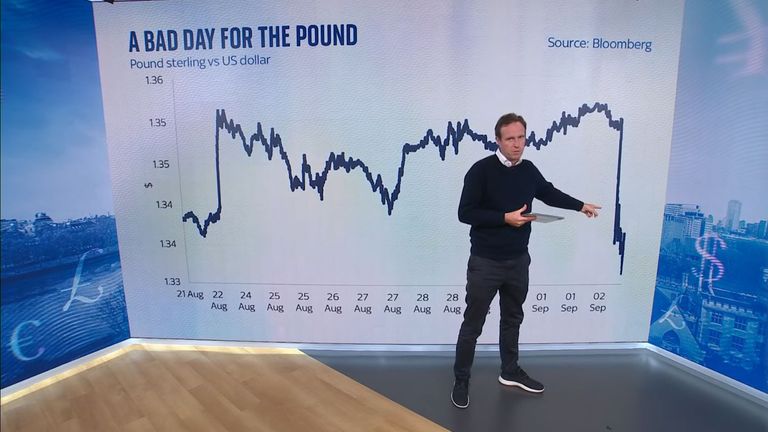
The spiked borrowing cost also continued to cause a weakening in the…
[ad_2]


