

[ad_1]
Hot, humid, loud and proud: the climate protest in the city of Belem was the embodiment of the Amazonian rainforest that surrounds it.
Hawkers brought carts selling bananas, mangoes and coconuts – while demonstrators bore umbrellas, hats and fans to shelter from the scorching tropical sun.
After a week of dreary negotiations at the COP30 climate talks, the streets were alive with the drumming of maracatu music and dancing to local carimbo rhythms on Saturday.
It was a carnival atmosphere designed to elevate sober issues.
Among those out on the streets were Kayapo people, an indigenous community living across the states of Para and Mato Grosso – the latter at the frontier of soy expansion in the Brazilian Amazon.
They are fighting local infrastructure projects like the new Ferrograo railway that will transport soy through their homeland.
The soy industry raises much-needed cash for Brazil’s economy – its second biggest export – but the kayapo say they do not get a slice of the benefit.
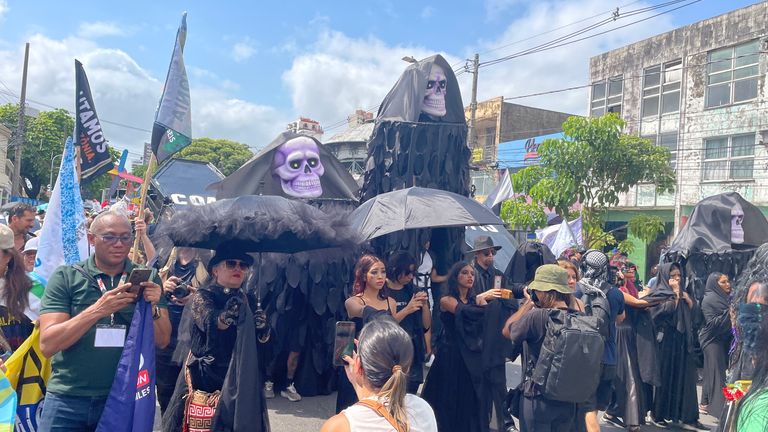
The climate protest
Read more:
Cop out: Is net zero dead?
COP30: Are climate summits saving the world – or just hot air?
Uti, a Kayapo community leader, said: “We do not accept the construction of the Ferrograo and some other projects.
“We Kayapo do not accept any of this being built on indigenous land.”
Many Brazilian indigenous and community groups here want legal recognition of the rights to their land – and on Friday, the Brazilian government agreed to designate two more territories to the Mundurucu people.
It’s a Brazilian lens on global issues – indigenous peoples are widely regarded as the best stewards of the land, but rarely rewarded for their efforts.
In fact, it is often a terrible opposite: grandmother Julia Chunil Catricura had been fighting to stay on…
[ad_2]


