

[ad_1]
Donald Trump has been unambiguous that Venezuela’s huge oil reserves, and the commercial opportunity they represent for American oil companies, were a primary motivation for the removal of President Nicolas Maduro.
Venezuela has the largest reserves on earth, with an estimated 300 billion barrels lying untapped, equating to 17% of global reserves, and more than Saudi Arabia, Iran, Iraq, and more than three times the reserves in the United States.
The bulk of Venezuela’s oil lies in the central Orinoco belt, south of the Orinoco river, in oilfields covering around 50,000sq km that may be the largest hydrocarbon deposit on the planet.
And it is not just how much oil there is, but the type that matters. Venezuelan oil is extra-heavy crude, used for making diesel, jet fuel, asphalt and as a raw material in petro-chemicals.
Venezuela crisis: Follow the latest developments
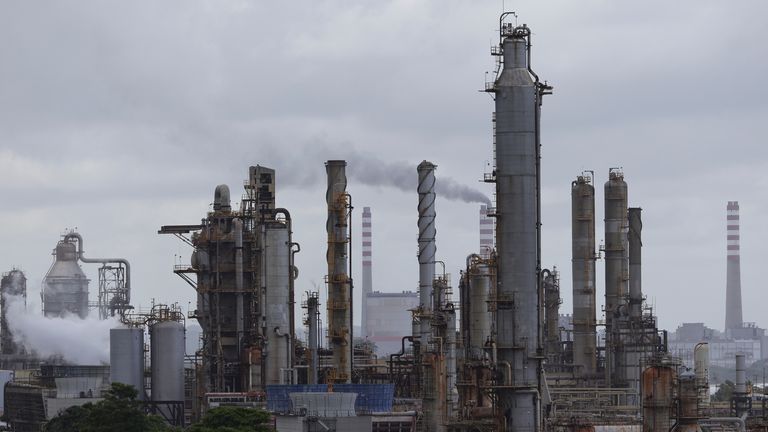
The Venezuelan state oil company PDVSA’s El Palito refinery. Pic: AP
Because it’s highly viscous – thick and sticky – it’s more complex to extract, and requires refinement – but perhaps crucially, while the US does not have large reserves of this kind of crude, it does have refineries that can manage it.
Despite its massive reserves, Venezuelan production is relatively puny and has been in decline for decades.
In the 1960s and 1970s, when, as elsewhere in Latin America and the Middle East, American and British oil companies controlled the industry, production peaked at around 3.5 million barrels a day – around 7% of global output.
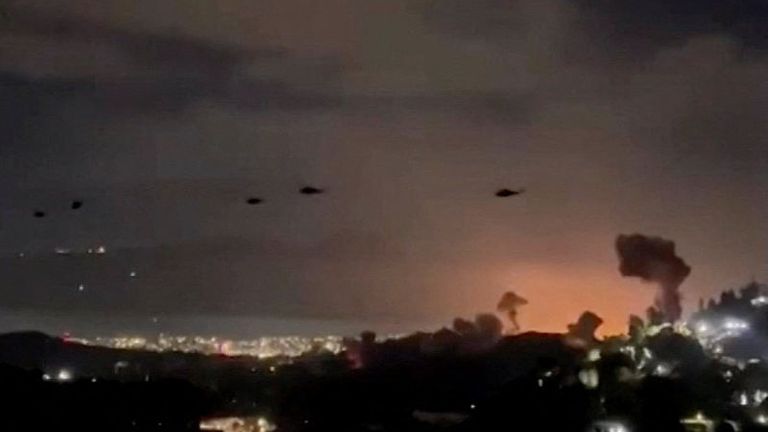
The US struck Caracas at about 2am local time on Saturday.
Following the election of Hugo Chavez and the nationalisation of the industry, production fell, declining further under his successor Nicolas Maduro and plummeting after the imposition of sanctions in 2019.
Today, Venezuela…
[ad_2]


