

The sanctions unveiled by Boris Johnson today against certain Russian banks and individuals fell well short of what some had been expecting.
That was certainly the impression created as MPs, including Sir Iain Duncan Smith, one of Mr Johnson’s predecessors as Conservative Party leader, queued up to urge the PM to go further.
That he has not may well be, as the Labour leader Sir Keir Starmer suggested, because the UK government may wish to hold back further, more stringent, measures in the hope of deterring Vladimir Putin from further aggression against Ukraine.
Mr Johnson himself confirmed that in the Commons by talking about “keeping something in reserve” and this only being a “first barrage”.
Yet it is notable that the five Russian banks on which sanctions were announced today – Rossiya, IS Bank, General Bank, Promsvyazbank and the Black Sea Bank – are all relatively small.
The bigger Russian lenders, the likes of Sberbank, VTB Bank, Gazprombank, Alfa Bank and VEB, were all notable by their absence.
Sberbank, through which more than half of all Russian wages and pensions flow, would have been an obvious target.
Moreover, in sanctioning the three high net worth individuals identified by the PM today – Gennady Timchenko, Boris Rotenberg and Igor Rotenberg – Britain was merely playing “catch-up” with the United States.
Washington first sanctioned Mr Timchenko, a co-founder of the commodity trading firm Gunvor, as long ago as 2014.
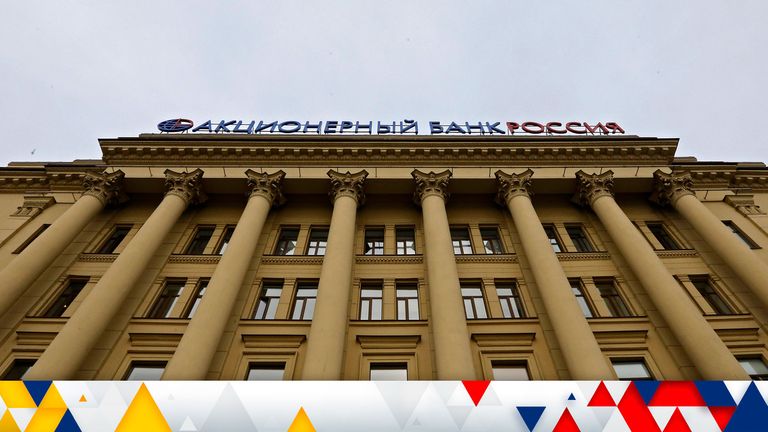
The Russian banks facing sanctions, including Rossiya, are all relatively small
Igor Rotenberg and his uncle Boris, who co-owned the gas pipeline and electricity power line construction firm Stroygazmontazh, were also sanctioned by the US at that time.
So, while these sanctions will clearly have an…
Source : skynews


