

“There is no longer any city there. There is no longer a city of Mariupol…there isn’t a single residential building left. Only 10% of the people are left there. Just retirees without money or (those without) cars who can’t escape (and) people who can’t walk,” Tania said from the relative safety of a temporary shelter in Dnipro.
“We did not bathe for three weeks, (we) went to the toilet on a bucket and in a bag,” Tania wrote in a diary she updated each day from her underground hiding place. She shared her diary entries with CNN.
The family rarely left the cellar unless it was absolutely necessary to survive — leaving only to find food and water, and once to help bury neighbors killed by Russian artillery while waiting in line for food.
“The problem is that in our city, we didn’t have anything. No mobile connection. No internet connection. Everything was cut. The gas supply, the water supply. The lights,” Dmytro told CNN. “We were cooking outside, making the fire. Taking wood from the parks. Because there was no other option to survive — sharing food with our neighbors, our relatives.”
The couple said it felt like Russian forces were targeting groups of civilians waiting in line for food, water, or at a pharmacy.
“They were just killing us. If we gathered together in a group to find water, they just shot at us,” Tania said.
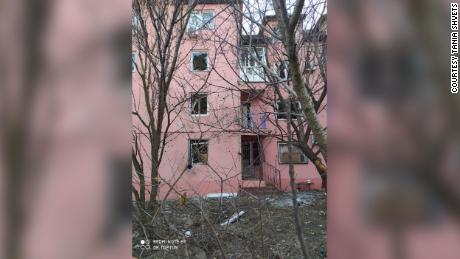
On the 11th day of the Russian invasion (March 6), she wrote in her diary: “A hard attack has begun. They were shooting from everything and everywhere, there was a shelling of houses again. Today there is not a single kiosk left, even empty ones are being opened and people take out everything from there: bags, cartons, vitamins from pharmacies … looting has become a way of survival.”
“Why the killing of civilians? Why? For what? We respect all (of) the world,” he told CNN.
Dark…
Source : cnn


